Inside a triathlon FIT file: what my watch really recorded at IRONMAN 70.3 Venice-Jesolo
On 3 May 2026 I raced IRONMAN 70.3 Venice-Jesolo: 1.9 km in the Adriatic,
90 km of pancake-flat Veneto tarmac, 21.1 km of running along the Jesolo
seafront. My Suunto Race 2 recorded all of it into a single 411 KB .fit
file — five sessions, 15,807 records, 4,819 heartbeat intervals, and two
button mistakes I didn't know I'd made until I parsed the file.
I've spent this year building chiptime, a FIT parser with a standing rule against taking a workout file's word for anything. So once the medal was on the shelf, I did what any data-inclined triathlete with a parser habit would do: I took my own race apart. Not a race report — a data autopsy. It turned out to be a great specimen precisely because it's a healthy file recorded by a fallible human — and because, as I discovered when I later exported the ELEMNT file from my handlebars, this race left behind two recordings that could cross-examine each other.
One file, five sessions
A triathlon FIT file is a multisport activity: one file, one timeline,
several session messages back to back. One parse call gets all of it:
import chiptime

result = chiptime.parse("venice-70.3.fit")
for s in result.activity.sessions:
    print(s.sport, s.start_time, s.derived.distance_m, s.derived.timer_time_s)
swimming    2026-05-03 06:01:46+00:00    519.0     522.0
transition  2026-05-03 06:38:13+00:00   1255.0     471.0
cycling     2026-05-03 06:46:05+00:00  88885.0    8871.0
transition  2026-05-03 09:13:58+00:00     99.0      70.0
running     2026-05-03 09:15:09+00:00  20463.0    5869.0
Bike, transitions, run: plausible. But the swim says 519 metres. The swim at Venice-Jesolo is 1,900 metres, and I did swim all of it — the salt in my sinuses was conclusive. So where did 1.4 km of the Adriatic go?
Mistake #1: the swim that shrank
The CLI summary answers it in one line:
$ chiptime parse venice-70.3.fit
file_type: activity   parts: 1   mode: lenient
device: suunto product=66
session[0] swimming: records=522  distance=519m  elapsed=2187s  timer=522s  ...
gaps: manual_stop(1667s)
The swim session's elapsed time is 36:27 — about right for my swim. Its timer time is 8:42. The difference is a gap, and chiptime doesn't just report a hole in the data, it classifies it with evidence:
result.activity.gaps
# [Gap(kind='manual_stop', duration_s=1667.0,
#      evidence='timer stop (manual) at 06:10:23 inside the gap')]
Eight and a half minutes into the swim, at the 519 m mark, the watch recorded a manual timer stop. Not a crash, not a dead battery — the event log shows a deliberate button press, most likely my wrist smacking the water or a wetsuit sleeve doing the pressing. The timer sat stopped for 27 minutes and 47 seconds while I swam the remaining 1.4 km, and I restarted it at the swim exit — the next event is a manual start at 06:38:08, and the GPS track resumes right at the beach.
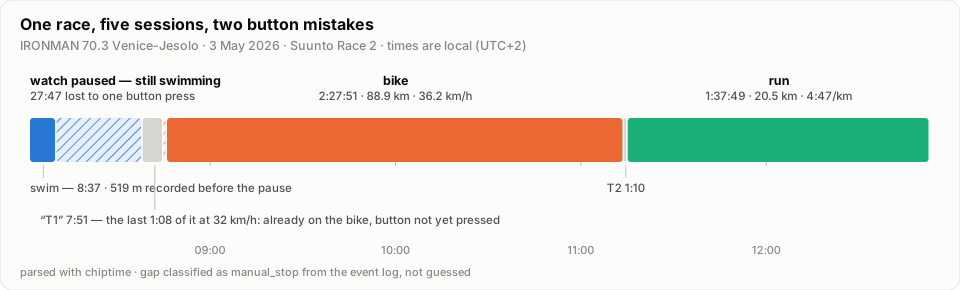
The distinction matters. A gap that overlaps a stopped timer with a manual
stop event inside it is classified manual_stop; the same hole with no
events would be corruption or unknown, and up to ~25 s with no events is
smart_recording — the four look identical if all you do is subtract
timestamps. chiptime never interpolates across any of them: the 519 m the
device measured stay 519 m, the missing 1.4 km are honestly missing, and
the classification tells you why.
For what it's worth, the 519 recorded metres were good ones — the first auto-lap says 1:00 for the opening 100 m (race-start adrenaline, plus a little open-water GPS optimism), settling to ~2:00/100 m by the fifth. Every open-water racer knows that shape: sprint for clear water, then the sea collects its tax.
Mistake #2: the transition that was secretly a bike leg
Look at the "transition" session after the swim: 7:51 and 1,255 metres — a long way to walk barefoot. Its declared max speed is 9.98 m/s, which is 36 km/h. I do not run through transition at 36 km/h.
What happened: I left T1, mounted the bike, and forgot to press the button that advances a multisport activity to its next leg. The watch kept filing everything under "transition" until I noticed. The file can't tell you what I did — it faithfully records what I pressed — but the streams can reconstruct reality. Find the moment jogging became riding:
t1 = result.activity.sessions[1]
speed = t1.records.stream("speed").values   # m/s, null where absent
for i in range(len(speed) - 10):
    window = speed[i : i + 10]
    if all(v is not None and v > 4.0 for v in window):
        print(t1.records.time[i], t1.records.stream("distance").values[i])
        break
# 2026-05-03 06:44:57+00:00  1168.0
Ten consecutive seconds above 4 m/s starting at 06:44:57. Before that point: 649 m at a 7.6 km/h average — an actual transition jog. After it: 68 seconds at 32 km/h average, safely on the bike, still labelled "transition". My real T1 was about 6:45; the remaining 1:08 and 606 m belong to a bike leg that officially measures 88.9 km in the file but was really ~89.5.
Two lessons from one race: session boundaries in a multisport file are button presses, not ground truth — and per-second streams are the receipts that let you audit them. In my defence: if you've never tried operating a wrist computer during a flying mount with your heart rate in the 160s and your brain still somewhere in the Adriatic, know that button-pressing is the first skill to go.
The heart-rate sensor died quietly, and the file knows exactly how
Here's the summary the watch wrote for the bike leg, next to what the per-second records actually contain:
bike = result.activity.sessions[2]
bike.declared.avg.heart_rate        # 152  — what the device claims
bike.derived.avg.heart_rate         # 122.8 — mean of the actual samples
bike.discrepancies
# [Discrepancy(field='avg.heart_rate', declared=152.0,
#              derived=122.83, delta=-29.17)]
A 29 bpm disagreement between a session summary and its own records is not a rounding difference — something is deeply wrong, and chiptime's job is to surface it, not to pick a winner. The coverage numbers tell the story:
hr = bike.records.stream("heart_rate")
valid = [v for v in hr.values if v is not None]
len(valid) / len(hr.values)         # 0.239 — 24% of the ride has HR at all
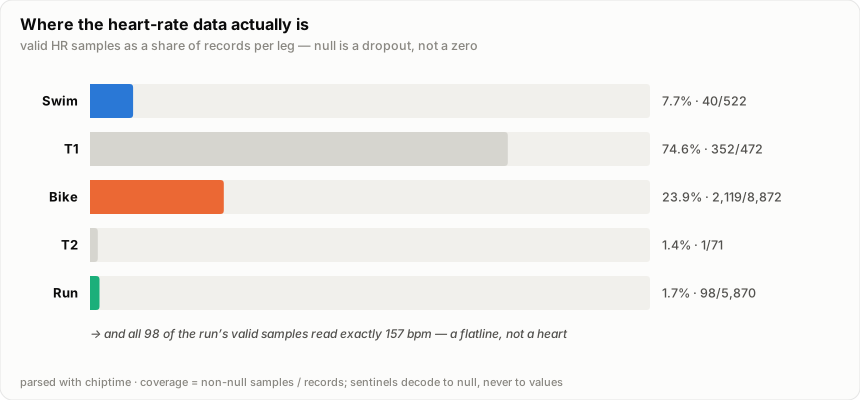
Whatever was measuring my pulse that morning gave up progressively: patchy in the water, decent through T1, one sample in four on the bike — and then, for the entire half marathon, 98 valid samples out of 5,870 records, every single one of them reading exactly 157 bpm. That's not a heart, that's a stuck register. If you ever wondered why your platform of choice showed a suspiciously tidy "avg HR 157" for a race where you nearly turned inside out — this is what it looks like at the byte level.
Two rules I baked into chiptime's contract make this analysis possible:
- Zero ≠ null, always. A FIT field that's absent decodes to
null, never to0— so dropouts can't drag an average down, and coverage is measurable instead of invisible. - Declared and derived totals both ship, with disagreements listed in
discrepancies[]. The device's 152 might come from a sensor-side average computed before the samples were lost; the records' 122.8 is polluted by whatever garbage the dying sensor did write. Neither number deserves your trust, and now you know that — which beats a dashboard confidently displaying either one. (Keep this strap in mind: a second witness takes the stand in the next section.)
While we're auditing summaries: this file also contains a lap message claiming a 5,000 m swim lap completed in 8:30, another claiming 1,000 m of running inside a 70-second transition, and session calorie counts of 2 kcal for the swim and 661 kcal for the eight-minute T1. Summary messages are where firmware bookkeeping goes to improvise. Streams don't improvise.
The power paradox: 8,872 zeros, and the file that had the answer
The bike power stream is a lovely inversion of the null rule:
There was a power meter on that bike — the Suunto just wasn't paired to it — so the watch wrote a literal zero for every one of the 8,872 seconds of the bike leg. Those aren't sentinels — they're real encoded values, so chiptime faithfully reports an average of 0 W, and the analytics layer calls the situation out rather than manufacturing a number:
session 3: cycling
  2:27:51 · 88.89 km · 36.2 km/h (moving) · avg 0 W · avg HR 123
  COASTING_HIGH: 100% of samples at 0 W (coasting).
An all-zero stream with perfect coverage is the signature of no sensor paired — the opposite failure mode of the heart-rate strap (real sensor, missing values). You need both concepts, zero and null, to tell those stories apart, which is exactly why chiptime refuses to conflate them.
But the watts weren't lost — the ELEMNT ROAM on my handlebars was running its own recording, paired to the 4iiii meter the watch never met. Its file starts at 06:46:07, two seconds after I finally pressed the Suunto's leg button: minute one of my bike leg was evidently device administration at 32 km/h (see mistake #2). Parse the second file, and the ride my watch couldn't see appears in full:
from chiptime import metrics

wahoo = chiptime.parse("venice-bike-elemnt.fit")
ride = metrics.analyze(wahoo).sessions[0]
ride.power_zones["basis"]     # 'file:power_zone' — zones from the file itself
ride.weighted_avg_power       # 207.1
ride.variability_ratio        # 1.035
ride.work_kj                  # 1751.2
ride.power_curve              # {5: 745.2, 60: 279.2, 300: 226.4, 1200: 211.3}
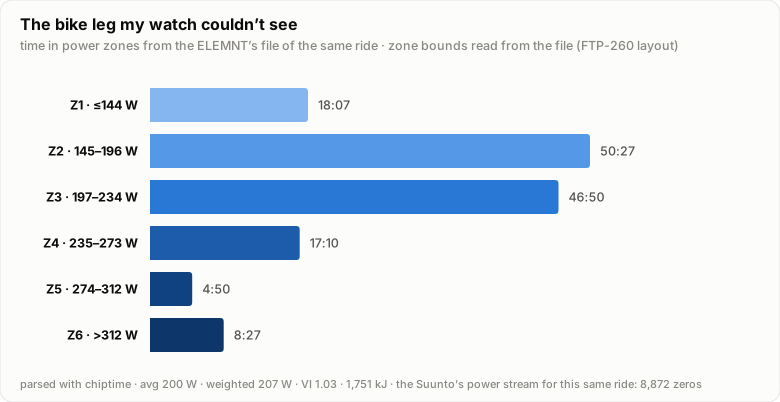
Now the bike leg finally makes athlete-sense. 200 W average, 207 W weighted, and a variability index of 1.035 — on a course with 15 m of climbing you pick one wattage and defend it, and the file says I did. Against the FTP-260 zone table the ELEMNT wrote into the file, that's an intensity right around 0.80: the textbook ceiling for a 70.3 bike, hard enough to matter, restrained enough to leave a run in the legs. The 4:47/km half marathon that followed is the receipt. The fuelling bill was 1,751 kJ — cycling's tidy coincidence makes that roughly 1,750 kcal burned before the run even started — and the one moment of drama the power curve remembers is a 745 W, five-second surge at km 15, from 29 to 40 km/h. Somebody got overtaken properly.
Two recorders, one ride — and the agreement between them is the most reassuring table in this post:
| Suunto Race 2 (wrist) | ELEMNT ROAM (bars) | |
|---|---|---|
| Distance | 88,885 m | 88,929 m |
| Avg speed (from streams) | 36.2 km/h | 36.6 km/h |
| HR samples heard | 2,119 (23.9%) | 2,120 (24.3%) |
| Declared avg HR | 152 | 77 |
| Power | 8,872 zeros | 200 W avg, 100% coverage |
Forty-four metres of disagreement across 89 km. And the strap gets its verdict: two independent recorders each heard ~2,120 heartbeats from a sensor that only spoke a quarter of the time, while their two summary averages — 152 and 77 — miss in opposite directions. The culprit even has a name in the second file's device roster: a Wahoo TICKR, faithfully logged by a Wahoo head unit while it failed. The autopsy stands, cross-examined: the strap was the problem, and no single summary number was ever going to tell me that.
(The ELEMNT file also trips the same stop → stop_all shutdown quirk I
dissect in the Tours teardown —
same device, same six-line shutdown handshake, same honest flag in
discrepancies[].)
Meanwhile the Suunto's run has genuine power — 100% coverage from its wrist-based running power model, averaging 260 W. Same field name in the same file as the 8,872 zeros, completely different provenance. Check coverage and uniqueness before you trust any stream; it's three lines of code.
What held up beautifully
Plenty did — this is a good watch having a hard day, not a bad file.
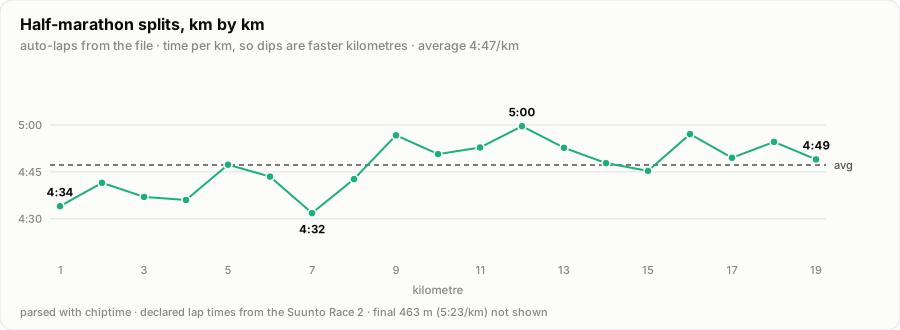
The run is textbook: 20.46 km at 4:47/km on 1 km auto-laps, fastest
kilometre 4:32, slowest 5:00, a 4.6% positive split that chiptime's
analytics flag without ceremony (PACING_POSITIVE_SPLIT). A 4.6% fade is
the polite amount — the kind you negotiate with at km 16 rather than
surrender to, and the direct dividend of that 0.80-intensity bike. The
wrist sensor logged a running cadence of 87.7 rpm — a 175
steps-per-minute metronome that barely wavered. The bike's
sixteen full 5 km auto-laps sit between 7:54 and 8:50 — 36.2 km/h moving
average with a total elevation gain of 15 metres in 88.9 km, which is
the flattest ride I will ever do. The barometric altimeter spent the whole
race between −9.6 m and +6.2 m and briefly decided the seafront promenade
was below sea level. Venice things.
And a few things you may not know your file contains:
- 4,819 R-R intervals — beat-to-beat heartbeat timings in 2,391
hrvmessages, exposed asresult.activity.hrv_intervals_s, recorded even while the displayed heart rate was failing. - A developer field named
recovery_time, registered by an application whose 16-byte ID decodes to the ASCII stringSuuntoFitExport1. After the final session it prescribes 318,240 seconds of recovery — 3 days and 16 hours. The watch wasn't wrong. - A provenance log for the parse itself: this file's timer events are
slightly unbalanced across the five sessions (the final leg has a stop
with no start inside its own slice), so chiptime records
TIMER_STOP_SYNTHESIZEDand aTIMER_STOP_WITHOUT_STARTwarning instead of silently patching things. Every decision the parser makes about your data is inresult.provenanceandresult.warnings, with stable machine codes.
Parse your own race
Everything above is the public API plus one real file:
pip install chiptime
chiptime parse race.fit            # summary with discrepancies and gaps
chiptime parse race.fit --json     # deterministic canonical JSON
chiptime analyze race.fit          # sport-aware analytics per session
The rules that made this teardown possible — never lose data silently, zero ≠ null, declared and derived, classify gaps instead of guessing — are the reason I started writing chiptime in the first place. They're pinned down as the contract and enforced by a conformance corpus on every commit.
In the companion post I do the same teardown on the opposite kind of file: the Wahoo ELEMNT ROAM file from my full-distance IRONMAN bike leg — seventeen streams, near-perfect sensor coverage, and a shutdown quirk that found a real bug in my own timer heuristic.
Total damage in Venice: 4:51:12 from the first beep to the last, two button mistakes, one dead heart-rate sensor — and, thanks to the second recorder on the handlebars, a bike leg recovered in full: 200 W held for 2:26, priced exactly right to run 4:47s afterwards. The files remember everything. You just need a parser that repeats them honestly.